

CfP International Conference on Arab-Islamic Encounters with the Age of Modernity: MODERN MOROCCAN THOUGHT 1800-1950s, Rome 10-11 June 2027
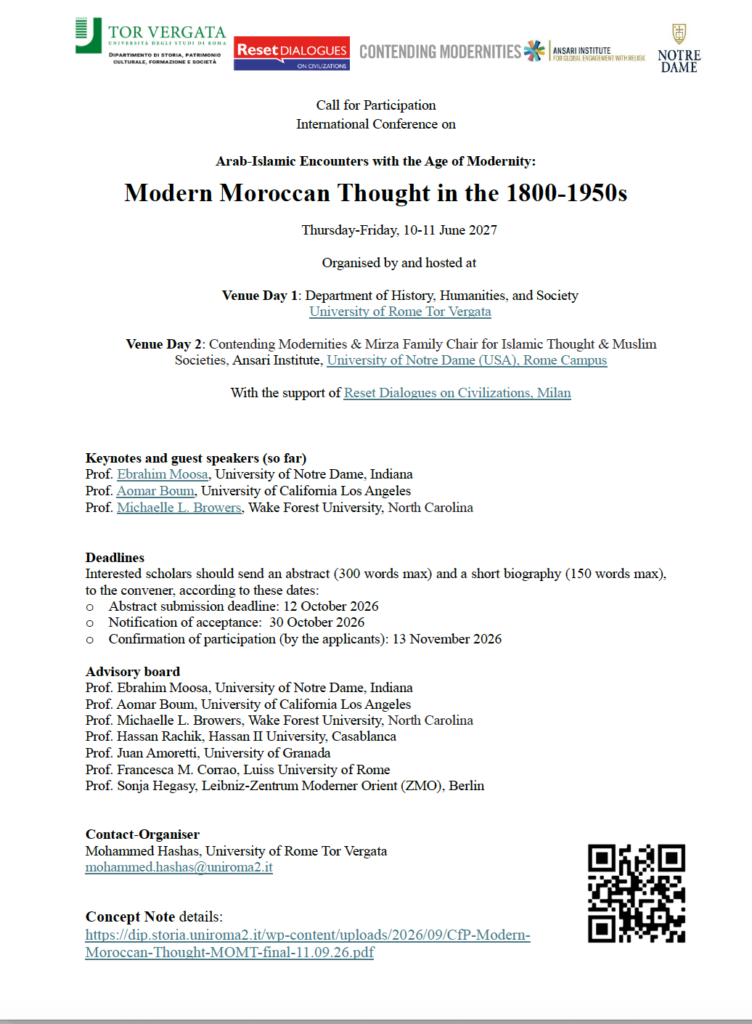
Call for Participation
International Conference on
Arab-Islamic Encounters with the Age of Modernity:
Modern Moroccan Thought in the 1800-1950s
Thursday-Friday, 10-11 June 2027
Organised by and hosted at
Venue Day 1: Department of History, Humanities, and Society
University of Rome Tor Vergata
Venue Day 2: Contending Modernities & Mirza Family Chair for Islamic Thought & Muslim Societies, Ansari Institute, University of Notre Dame (USA), Rome Campus
With the support of Reset Dialogues on Civilizations, Milan
Concept note:
Morocco is closer to the East than to the West in its spirit, concepts, reasoning, habits and cultures, religion and history. But we must not make a clear-cut distinction between the East and the West; the West is not only West and the East is not only East; there is as much of the East in the West as of the West in the East.
Mohammed Abed al-Jabri (1935-2010) [original in Arabic, 1967] 2017.
This conference focus, the first of its kind in the field, seeks to bring together scholars that study Moroccan intellectual history as a case study of how Arab-and-Islamic worlds have reacted to modernity and its multiple challenges, and how they think through it from different disciplines and perspectives from the 1800s to the 1950s. This conference is a sequel in a vision that seeks to deepen researching the intellectual dynamics of the edges of the classical Arabic and Islamic worlds, and thus enrich Moroccan Studies that has seen a particular growth of interest in English language – and a few other languages – during the last two decades.
After the publication of the comprehensive volume Contemporary Moroccan Thought: On Philosophy, Theology, Society, and Culture (Brill, 2025, 830 p.), this conference comes to announce the ongoing project for a second gross volume on Modern Moroccan Thought in the period of 1800-1950s, i.e., the period of contact with Europe and its modern episteme and politics, and how this has awakened the Mashriq and the Maghrib alike to the new age of modernity and its challenges at all levels: national, regional, and global; individual, communal, and societal. Theology, jurisprudence, Sufism, philosophy, letters and the arts, and politics are the major fields that reflect a society’s intellectual dynamics. The volume covers some of the major intellectuals, male and female, and their ideas that have marked the “Moroccan modern awakening” (ruwād al-nahḍa al-maghribiyya).
Overall, this work will revolve around these four major axes (or disciplines), under which various sub-themes could be listed: 1) History, 2) Theology (or Religion in the broad sense), 3) Society, and 4) Culture. Besides these disciplinary division, work will be divided according to a) intellectuals projects, b) themes related to the topic, following a 3) chronological order, from the pre-colonial period to the colonial period. The post-colonial period is covered in the abovementioned volume Contemporary Moroccan Thought.
While work on the volume is ongoing (work period 2025-2029), this conference aims to visualize and share these studies by bringing the scholars together as a way of further enriching the discussions and the scholarly community in the field. Comparing Moroccan scholarship with similar/different scholarly preoccupations in other parts of the Arab-Islamic worlds and traditions are welcome.
Below are the leading questions that guide this conference, and the volume behind it, and the sub-themes that can enrich it:
Guiding questions and themes:
o Who speaks for the modern Moroccan intellect of the 1800-1950s?
o How and what did modern Moroccan scholars of the 1800-1950s think about concepts like Society, the State, History, Constitutionalism, Liberty, Equality, Justice, Democracy, and Environment?
o How did modern Moroccan scholars think of the past, present and future of their society, and the larger Arab-Muslim world then?
o What major classical and modern texts and ideas influenced Moroccan scholarship in the 1800-1950s?
o What major issues preoccupied modern Moroccan thinkers of the 1800-1950s?
o What internal and external factors pressured them to theorize and write?
o What were the geo-political relations of Morocco in the 1800s with its neighbours East and West, North and South?
o How was the “other” depicted in Moroccan scholarship then?
o What is the place of the Quran, theology, jurisprudence, Sufism, philosophy, letters and the arts in modern Moroccan scholarship?
o What role did the printing and journalism play in the rise of Moroccan socio-cultural awakening?
o What role did women play in the period under focus?
o What role did Awqāf endowments and Sufi brotherhoods play in society then?
o What role did modern schools and their intellectual directors/founders play in society then?
o What major cities played intellectual roles in the modern Moroccan awakening?
o What artistic expressions best represent the Morocco of the 1800-1950s? (Architecture, environment, literature and poetry, music, cinema, theatre, etc.)
N.B.
1. Priority will be given to the study of Moroccan intellectual projects, i.e., how the Moroccans wrote and thought in the indicated period about the themes above.
2. There are no funds available to encourage young and disadvantaged scholars to join, but basic services (coffee breaks and light lunches) will be offered to all participants.
3. Selected papers will be invited to the conference, and also to join the ongoing volume project, if the themes proposed are not covered yet.
4. The language of the conference proceedings is English.
Keynotes and guest speakers (so far)
Prof. Ebrahim Moosa, University of Notre Dame, Indiana
Prof. Aomar Boum, University of California Los Angeles
Prof. Michaelle L. Browers, Wake Forest University, North Carolina
Deadlines
Interested scholars should send an abstract (300 words max) and a short biography (150 words max), to the convener, according to these dates:
o Abstract submission deadline: 12 October 2026
o Notification of acceptance: 30 October 2026
o Confirmation of participation (by the applicants): 13 November 2026
Advisory board
Prof. Ebrahim Moosa, University of Notre Dame, Indiana
Prof. Aomar Boum, University of California Los Angeles
Prof. Michaelle L. Browers, Wake Forest University, North Carolina
Prof. Hassan Rachik, Hassan II University, Casablanca
Prof. Juan Amoretti, University of Granada
Prof. Francesca M. Corrao, Luiss University of Rome
Prof. Sonja Hegasy, Leibniz-Zentrum Moderner Orient (ZMO), Berlin
Contact-Organiser
Mohammed Hashas, University of Rome Tor Vergata

Mohammed Hashas
Scholar of Islam, contemporary Arab and Islamic philosophy and theology, Islam in Europe, European Islamic thought, Moroccan thought, and religion and politics in the Arab World.